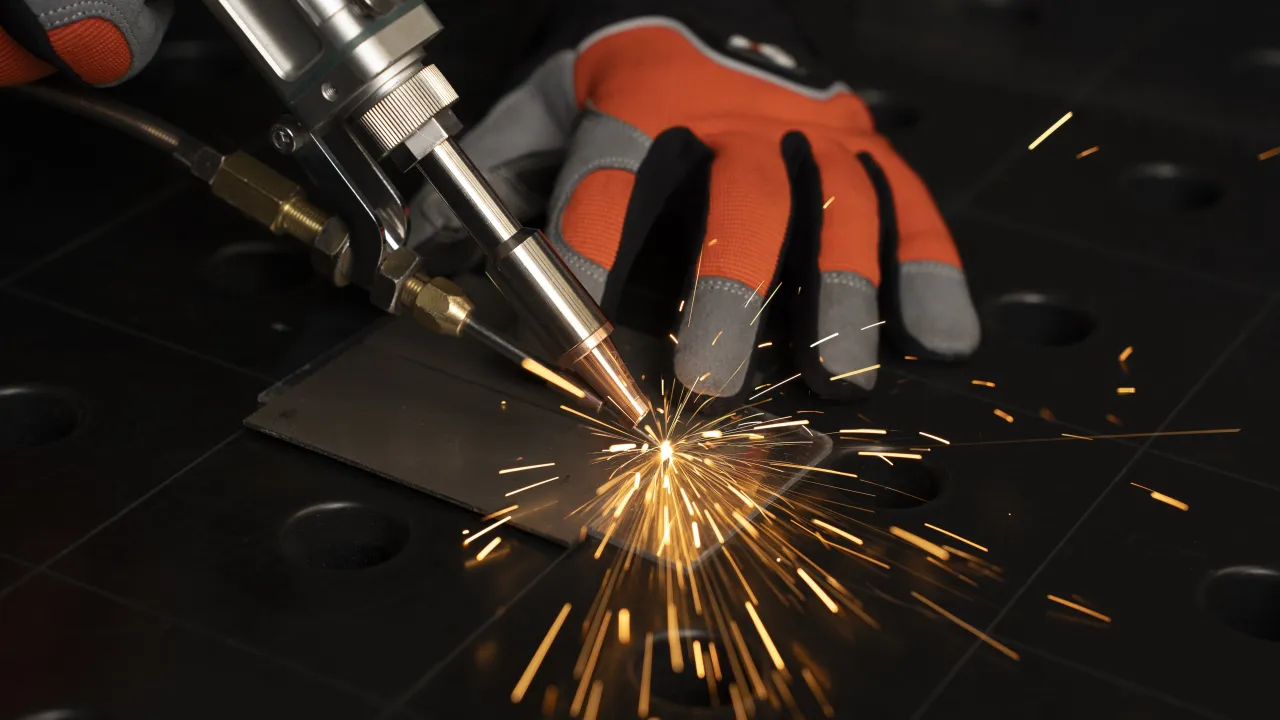
Modern industrial manufacturing places ever-increasing demands on quality, speed, and production efficiency. One technology that effectively meets these requirements is laser welding. FANTECH Europe has specialized in this field for many years, delivering advanced laser technologies to customers across the Czech Republic and international markets.
In addition to its standard laser equipment, the company also specializes in custom-designed laser welding workstations. These are tailored to meet each customer's specific requirements—from the dimensions of welded components and workstation ergonomics to the required level of automation. Naturally, all systems comply with strict safety standards, ensuring maximum protection for both operators and the technology itself.
Laser welding is one of the most advanced methods of joining materials. It enables highly precise and strong welds while minimizing heat input into the material. As a result, welded components experience less distortion and require significantly less post-processing. In practice, this means not only higher product quality but also considerable savings in time and operating costs. Companies particularly value clean welds, high productivity, and the ability to process a wide range of materials. Adopting laser welding is therefore not only a technological innovation but also a strategic step toward strengthening competitiveness in an increasingly demanding market. Another important advantage is the balance between the technology's acquisition cost and its performance. Although the initial investment may be higher than with some traditional welding methods, the long-term benefits—higher production efficiency, lower scrap rates, and reduced finishing operations—often provide a very rapid return on investment.
Many companies are concerned about integrating new technologies into their existing manufacturing processes. However, FANTECH Europe's experience shows that a well-designed solution can be efficiently integrated into both smaller workshops and large-scale production lines. Every project begins with a detailed analysis of the customer's specific requirements and the design of the optimal solution. The modular design of the workstations also allows for future expansion as production needs evolve. Similar concerns often arise regarding the operation of laser equipment itself. Modern systems, however, feature intuitive controls and a wide range of functions that significantly simplify operation. That is why FANTECH Europe provides not only the technology itself, but also professional training and continuous support during implementation.
At FANTECH Europe, delivering the technology is not considered the end of the partnership, but rather its beginning. The company places great importance on customer feedback, regularly gathers experience from real-world operation, and continuously seeks opportunities to improve its products and services. Comprehensive warranty and post-warranty service, technical support, and expert consultations are standard. Every suggestion from customers is valued, and many product innovations and technical improvements have been developed directly from practical user experience. Customers can also test the equipment themselves at the company's showroom in Opava, where they can evaluate their own materials and verify results on real applications before making an investment.
Supporting the next generation of technicians and welders is another important part of the company's activities. FANTECH Europe has long cooperated with vocational schools and technical institutes by supplying educational models of its welding equipment for training purposes.
Students gain hands-on experience with modern technologies that are widely used in today's industrial manufacturing. A similar approach is applied when implementing new technologies in companies, where employee training is an integral part of every equipment delivery.
Representatives of educational institutions agree that the future of technical education lies primarily in sharing experience and open collaboration. Schools should inspire one another, encourage innovation, and work together to prepare students for the demands of modern industry. Connecting education with practical industrial experience is one of the most effective ways to educate future professionals.
We asked several FANTECH equipment users to share their experience with us. Here you will find feedback from both vocational schools and manufacturing companies that are already using these laser technologies in everyday practice.
Students show strong interest in laser welding and laser surface cleaning, mainly because they encounter these technologies online or through student projects. Although they do not yet have regular access to them at school or in the companies where they often work part-time, they are eager to gain hands-on experience. Laser technologies are perceived as a modern and attractive part of industry that can appeal to a broader group of young people, especially through their connection with robotics. Educational institutions also emphasize that training with modern technologies helps students better understand today's industrial practices and significantly improves their future employability.Ondrej Chlebo, Basic Organization of Technical Sports, Faculty of Mechanical Engineering, STU
Although the company is still in the early stages of implementing laser welding, the technology is gradually being adopted for an increasing number of projects. Its greatest advantages are considered to be high welding speed and minimal material distortion. Another interesting experience has been the successful use of the technology by employees with no previous welding experience, who are not influenced by habits acquired from traditional TIG or MIG welding methods. While laser welding offers many advantages, it also has certain limitations, such as the higher weight of the welding gun and constraints related to wire feeding. Based on the company's experience, laser welding is not the ideal solution for every manufacturer. However, for stainless steel products, where production speed, weld quality, and appearance are key factors, it can be an exceptionally efficient technology.Jindřich Tauchman, Tauchman SWS
The company first began considering the purchase of a laser welding machine approximately two years ago. The initial inspiration came from demonstrations of the technology found online. However, before making a decision, the management wanted to verify its benefits directly within their own production environment. The key factor was an on-site demonstration at the company, where the welders themselves had the opportunity to test the technology. After implementation, laser welding proved successful both from a technological and process perspective, as well as economically. The company considers the most significant benefits to be substantially higher productivity and a considerable reduction in post-processing operations.Pavel Gorda, GORDA stainless
At first, the transition to the new technology was not easy, as the welders approached it rather conservatively. Once they gained practical experience, however, they began using laser welding more frequently and now prefer it whenever possible. Before purchasing the technology, their biggest concern was operational safety. Practical experience also showed that laser welding has its limitations, for example when welding larger profiles, performing assembly work, or working in certain welding positions where the size of the welding head can become a limiting factor. According to the company's experience, laser welding is not suitable for every manufacturer and always depends on the specific production process. In their case, however, the technology is now used in more than 70% of their projects, and they are already considering investing in another machine.
The main motivation for purchasing a laser welding machine was the introduction of a new production line for modular filtration units made from structural and stainless steels. The company began using the technology on its first projects while simultaneously optimizing related manufacturing processes, particularly material preparation and the accuracy of assembling welded components. Compared to conventional MAG welding, the greatest advantages are considered to be zero post-weld distortion and spatter-free welding, which significantly reduces the need for subsequent grinding, cleaning, and other finishing operations. The newly trained operators have also embraced the technology, appreciating its versatility, efficiency, and productivity compared to conventional TIG and MIG/MAG welding methods. Before making the investment, the company carried out a comprehensive supplier evaluation, practical testing, and reference verification. Based on the results, it concluded that implementing handheld laser welding was the right step toward successfully launching the new production process. Although the technology has only been in operation for a short time, the company has not encountered any significant limitations and considers the investment highly successful. Based on its experience, the company recommends laser welding primarily to manufacturers of thin-walled structures, where it can significantly increase production productivity while eliminating many post-processing operations associated with weld finishing.Radek Shejbal, Donaldson Industrial Czech Republic
Did you find all the information you were looking for? Do you have a question?
Contact us